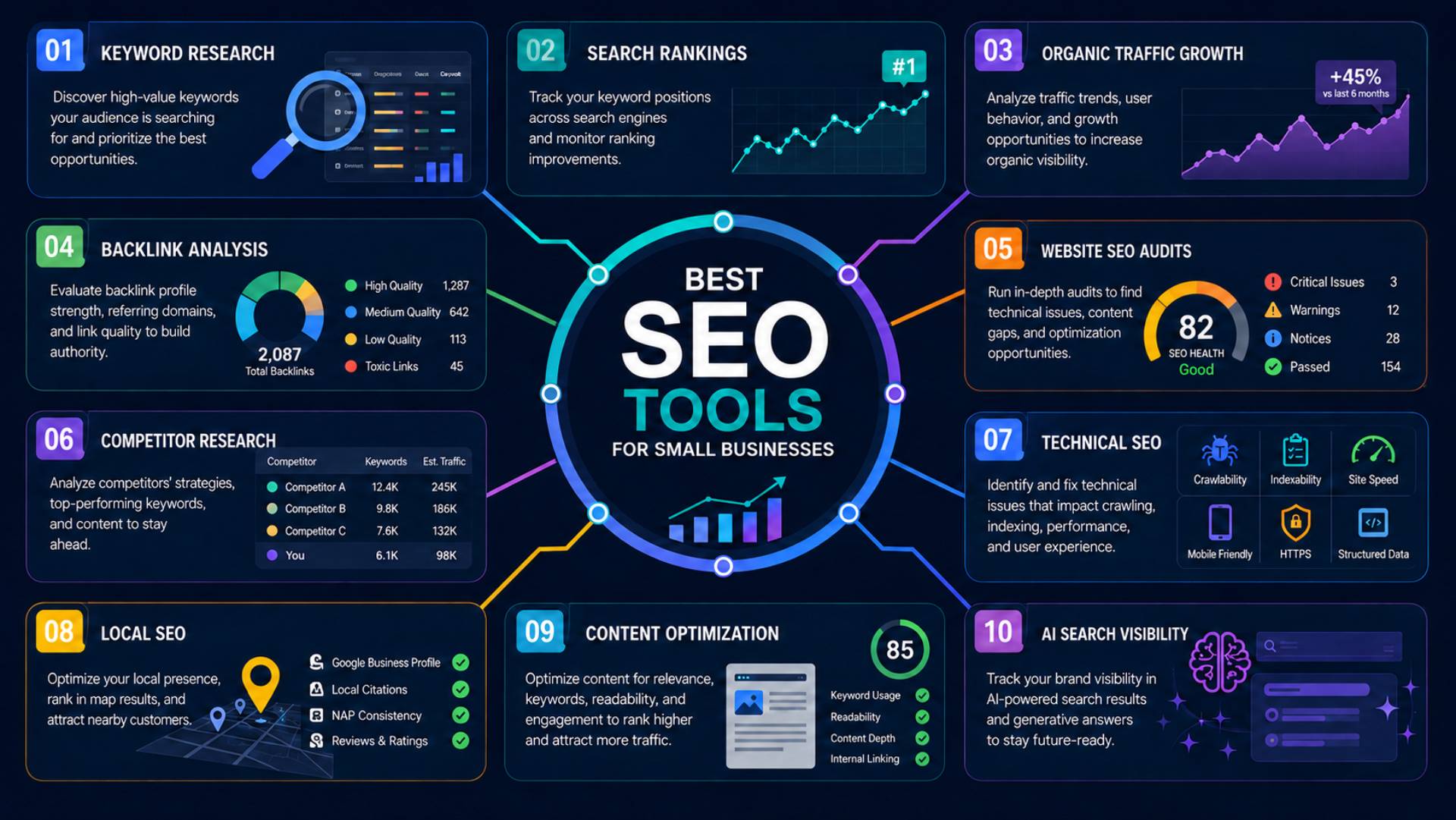
Small businesses do not need the biggest SEO platform. They need software that helps them find worthwhile keywords, identify website problems, monitor rankings, understand competitors, and measure whether SEO work produces results.
The challenge is that SEO software now ranges from free webmaster tools to platforms costing hundreds of dollars per month. Entry prices can be misleading when plans restrict tracked keywords, websites, users, crawls, exports, or AI-search monitoring.
We compared 2026 pricing, plan limits, SEO capabilities, ease of use, and suitability for smaller teams to identify the best SEO tools for small businesses. The rankings below are editorial assessments based on current product documentation rather than claimed hands-on testing.
Quick Answer
Semrush is our best overall SEO tool for small businesses in 2026 because its core plan combines keyword research, competitor analysis, rank tracking, backlinks, and site auditing in one platform. Ubersuggest is our best-value choice for businesses with one website, while Google Search Console is the best free starting point.
For specialist needs, Ahrefs stands out for backlink and competitor research, Screaming Frog SEO Spider is our technical SEO pick, and BrightLocal is better suited to businesses focused on local search.
Businesses with simple websites should start with free tools before committing to a recurring subscription.
Best SEO Tools for Small Businesses at a Glance
| SEO Tool | Best For | Starting Price | Free Option | Main Strength | Main Limitation |
|---|---|---|---|---|---|
| Semrush | Best overall | $139.95/month | 7-day trial | Broad all-in-one SEO coverage | Expensive for very small sites |
| Ubersuggest | Best value | $29/month | Free trial | Affordable one-site toolkit | Lower entry limits |
| SE Ranking | Rank tracking and small teams | $129/month | 14-day trial | Large tracking allowance | Higher price than budget tools |
| Ahrefs | Backlinks and competitor research | $29/month Starter | Limited free account | Strong research capabilities | Starter is heavily restricted |
| Google Search Console | Best free tool | Free | Yes | First-party Google data | No broad competitor research |
| Screaming Frog | Technical SEO | Free; $279/year paid | Yes | Detailed website crawling | More technical to use |
| BrightLocal | Local SEO | From $31/month | 14-day trial | Local rank and GBP tools | Specialist rather than all-in-one |
| Surfer | Content optimization | $49/month, billed yearly | Start-free option | Content optimization workflow | Not a complete SEO suite |
| Moz Pro | Traditional SEO suite | $49/month entry option | Trial availability | Established core SEO toolkit | Less attractive for some specialist needs |
| Bing Webmaster Tools | Bing and AI citations | Free | Yes | Search, backlinks and AI citation data | Bing-focused |
Pricing checked: August 2026. Prices and plan limits can change. Annual rates are identified where applicable.
Semrush’s SEO Toolkit Pro currently costs $139.95 monthly and supports five monitored websites, 500 tracked keywords and 100,000 crawled pages per month. Ubersuggest’s Individual plan costs $29 monthly for one domain and 125 tracked keywords.
SE Ranking Core costs $129 monthly, while annual billing lowers the equivalent rate to $103.20 per month. Ahrefs Starter costs $29 monthly, but the fuller Lite plan costs $129.
How We Selected and Rated the Tools
We evaluated each platform according to what a small business is likely to use rather than how many total features the vendor can advertise.
Our methodology weights:
| Criterion | Weight |
| Core SEO functionality | 20% |
| Value for small businesses | 20% |
| Ease of use | 15% |
| Keyword and competitor research | 10% |
| Technical SEO | 10% |
| Rank tracking and reporting | 10% |
| Integrations and workflow | 5% |
| Support and learning resources | 5% |
| AI and search evolution | 5% |
We also examined starting prices, websites or projects allowed, keyword limits, crawl capacity, users, free access, and whether important capabilities require a higher plan.
We did not assign artificial numerical scores. Terms such as best overall or best value are editorial assessments, while prices, limits, and documented features are verified product information.
1. Semrush — Best Overall SEO Tool
Why it made our list: Semrush covers most SEO jobs a growing small business is likely to handle: keyword discovery, competitor research, backlink analysis, position tracking, site auditing, and search visibility analysis.
Quick facts: Best for businesses wanting one central SEO platform. SEO Toolkit Pro costs $139.95/month and includes five websites, 500 tracked keywords, and 100,000 crawled pages monthly. A seven-day trial is available.
Key strengths: Its main advantage is breadth. A business can investigate competitors, plan keywords, track rankings, and diagnose technical issues without maintaining several subscriptions.
Where it falls short: Cost. Some reporting, content, local, and advanced AI capabilities involve higher plans or separate toolkits.
Best for: Growing businesses that regularly use several SEO functions.
Not ideal for: Owners needing only basic monitoring.
Editor’s verdict: Semrush provides the strongest overall package here, but its cost makes sense only when a business will actually use its research and monitoring capabilities.
2. Ubersuggest — Best Value for Small Businesses
Why it made our list: Ubersuggest offers a lower financial barrier than most full SEO suites while covering several core tasks needed by a one-site business.
Its Individual plan costs $29/month and currently includes one user, one domain, 125 tracked keywords, 1,000 page scans per domain, five competitors, and 150 searches per day. It also includes limited AI-related research and prompt features.
Key strengths: The interface and pricing structure suit solo entrepreneurs and smaller businesses that do not need agency-level data allowances.
Where it falls short: Limits become more important as a business adds websites, keywords, competitors, or deeper research requirements.
Best for: Beginners and budget-conscious businesses managing one main website.
Not ideal for: Larger SEO teams or companies requiring extensive competitor and backlink datasets.
Editor’s verdict: Ubersuggest is our best-value choice because its $29 starting point is easier to justify when SEO is important but not yet a large operational function.
3. SE Ranking — Best for Rank Tracking and Small Teams
Why it made our list: SE Ranking combines traditional SEO workflows with unusually generous tracking capacity for its entry platform tier.
Core costs $129/month, or $103.20 per month equivalent when billed annually. It supports 10 projects, one manager seat, 2,000 daily tracked keywords, 250,000 audited pages per month, and 100 daily GEO prompts. A 14-day trial is available without a credit card.
Key strengths: Daily tracking, multi-project capacity, auditing, competitor research, backlinks, and reporting make it suitable for marketers managing several sites or clients.
Where it falls short: At $129 monthly, it is no longer a particularly cheap alternative to larger platforms.
Best for: Small agencies, consultants, and businesses that care heavily about rank monitoring.
Not ideal for: One-site beginners with light tracking requirements.
Editor’s verdict: Choose SE Ranking when tracking volume and organized multi-project workflows matter more than obtaining the largest possible research ecosystem.
4. Ahrefs — Best for Backlinks and Competitor Research
Why it made our list: Ahrefs remains particularly useful for investigating competing websites, keywords, pages, and backlinks.
The important pricing distinction is between Starter at $29/month and Lite at $129/month. Starter includes 200 monthly credits, one unverified project, 50 Rank Tracker keywords, and no monthly report exports. Lite raises the limits substantially, including 750 tracked keywords and 100,000 crawl credits.
Ahrefs does not currently offer a conventional free trial, although it provides limited free account functionality for verified websites.
Key strengths: Strong competitor, keyword, content, and backlink research.
Where it falls short: The $29 headline price can create the wrong impression because Starter’s credit and export restrictions are significant.
Best for: Businesses where research and link analysis are central to SEO.
Not ideal for: Users expecting unlimited all-in-one functionality for $29.
Editor’s verdict: Ahrefs is a strong research platform, but businesses should compare the usable plan they need rather than choosing it based on Starter pricing alone.
5. Google Search Console — Best Free SEO Tool
Why it made our list: Every small-business website that depends on Google traffic should have Search Console configured before paying for more software.
Google describes Search Console as a free service for monitoring and troubleshooting a site’s presence in Google Search. It reports queries, clicks, impressions, indexing information, crawling issues, links, and other site data.
Key strengths: The data comes directly from Google and shows how your own website performs in Search.
Where it falls short: It is not designed for broad competitor keyword research, extensive backlink comparison, or conventional multi-engine rank tracking.
Best for: Every website owner.
Not ideal for: Businesses expecting one tool to handle competitive market research.
Editor’s verdict: Search Console should be part of the SEO stack regardless of whether the business later buys another platform.
6. Screaming Frog SEO Spider — Best for Technical SEO
Why it made our list: Screaming Frog provides detailed website crawling without forcing businesses into another monthly all-in-one subscription.
The free edition crawls up to 500 URLs. A paid single-user license costs $279 per year in the United States and removes the 500-URL crawl restriction while adding features such as advanced configuration, saved crawls, JavaScript rendering, crawl comparison, structured-data analysis, and integrations.
Key strengths: Excellent for finding broken links, redirects, metadata problems, duplicate pages, crawl issues, directives, and technical site patterns.
Where it falls short: It requires more SEO knowledge than beginner-focused dashboard products.
Best for: Technical audits and larger websites.
Not ideal for: Owners seeking keyword strategy or simple marketing recommendations.
Editor’s verdict: For technical SEO, Screaming Frog delivers far more focused crawling capability than most general-purpose SMB platforms.
7. BrightLocal — Best for Local SEO
Why it made our list: Local businesses have different requirements from national content websites. They need Google Business Profile auditing, local rank tracking, geo-grid visibility, citation monitoring, and review workflows.
BrightLocal’s Track platform is advertised from $31/month and includes local SEO audits, local rankings for up to 100 keywords and four competitors per location, and geo-grid tracking for selected keywords. A 14-day trial is available without a credit card.
Key strengths: The platform is built around local-search tasks rather than treating them as side features.
Where it falls short: Businesses focused mainly on national keyword research and backlinks will still need other tools.
Best for: Local service companies, stores, clinics, restaurants, and multi-location businesses.
Not ideal for: Purely online businesses without local-search needs.
Editor’s verdict: A local company may get more practical value from BrightLocal than from paying for another general SEO suite.
8. Surfer — Best for Content Optimization
Why it made our list: Surfer concentrates on planning, writing, and improving search-focused content rather than attempting to replace every SEO application.
Its Discovery plan costs $49/month when billed yearly and currently includes up to 120 content documents and tracking for 10 pages. Standard costs $99/month billed yearly and adds AI-visibility tracking for 25 prompts refreshed weekly.
Key strengths: Content guidelines, optimization workflows, page tracking, and integrations with platforms including WordPress and Google Docs.
Where it falls short: It is not a replacement for a deep backlink platform, specialist technical crawler, or complete competitor-research suite.
Best for: Businesses publishing SEO content regularly.
Not ideal for: Companies mainly needing rank tracking or technical auditing.
Editor’s verdict: Surfer makes the most sense when content production is already a major part of the company’s organic-growth plan.
9. Moz Pro — Best Traditional Beginner-Friendly SEO Suite
Why it made our list: Moz Pro offers a familiar combination of keyword research, rankings, crawling, backlink analysis, and established SEO metrics.
Moz’s current pricing material lists an entry-level option at $49/month for individuals managing one website. Its main Standard plan is $99/month, with Medium at $179 and Large at $299.
Key strengths: Broad core SEO functionality and a long-established educational ecosystem make Moz approachable for marketers learning structured SEO workflows.
Where it falls short: Buyers should check the current entry-plan limits carefully, and dedicated tools may provide stronger value for specific tasks such as daily rank tracking or technical crawling.
Best for: Beginners wanting a conventional SEO suite.
Not ideal for: Businesses selecting software primarily by tracking capacity or specialist functionality.
Editor’s verdict: Moz remains useful, but buyers should compare its actual limits against newer competitors rather than choosing it solely because of brand familiarity.
10. Bing Webmaster Tools — Best Free Tool for Bing and AI Citations
Why it made our list: Bing Webmaster Tools has become more useful in 2026 because it combines traditional webmaster data with visibility into Microsoft’s AI experiences.
The free platform includes keyword research, backlink information, SEO/GEO reports, Site Scan, and performance reporting.
Microsoft launched AI Performance in public preview on February 10, 2026. It reports citations from Microsoft Copilot, AI-generated Bing summaries, and selected partner integrations, including cited pages and grounding-query information.
Key strengths: Free search, technical, backlink, and AI-citation data.
Where it falls short: Bing data cannot replace Google’s own Search Console information.
Best for: Businesses wanting broader search visibility without another subscription.
Not ideal for: Teams needing a complete commercial SEO research platform.
Editor’s verdict: It costs nothing and now provides information many businesses would otherwise expect only from paid AI-visibility products.
Best Free SEO Tools for Small Businesses
A small business can build a surprisingly capable SEO workflow without purchasing software immediately.
A practical free stack includes:
- Google Search Console: monitor Google queries, clicks, impressions, indexing, crawling, and links.
- Bing Webmaster Tools: monitor Bing search, backlinks, Site Scan, keyword data, and Microsoft AI citations.
- Google Trends: compare search interest, regions, related searches, and changing demand.
- PageSpeed Insights: measure page performance and receive performance-related improvement suggestions.
- Screaming Frog Free: crawl websites of up to 500 URLs at a time.
- Google Business Profile: eligible local businesses can manage their presence on Google Search and Maps at no charge.
Free tools become limiting when you need detailed competitor keyword research, extensive backlink databases, systematic rank tracking, large crawls, multiple client websites, or automated reporting.
Free vs. Paid SEO Tools
| Need | Are Free Tools Usually Enough? | When Paid Software Helps |
| Google performance monitoring | Yes | Advanced reporting |
| Indexing diagnostics | Yes | Larger technical workflows |
| Keyword discovery | Partly | Deeper competitive research |
| Competitor analysis | Limited | Usually |
| Rank tracking | Limited | Regular monitoring |
| Technical audits | Often for small sites | Larger sites and automation |
| Backlink research | Limited | Competitive link analysis |
| Local profile management | Often | Multi-location monitoring |
| Multi-site reporting | Rarely | Agencies and larger teams |
Paid SEO software becomes worthwhile when it removes recurring manual work or provides competitive information that free first-party tools cannot supply.
How to Choose an SEO Tool for Your Small Business
Start with the outcome you want rather than the longest feature list.
If your goal is simply to understand existing Google traffic, Search Console may be enough. If you need competitor keywords and backlinks, a paid research platform becomes more useful. Local businesses should place heavier weight on local rankings, Business Profile data, and citations.
Next, check usable limits. A $29 plan is not necessarily better value than a $100 plan if you immediately exceed its keyword, project, export, or crawl allowance.
Look closely at:
- Number of websites or projects
- Tracked keywords
- Ranking update frequency
- Crawl capacity
- Competitors allowed
- User seats
- Data exports
- Reporting
- Add-on costs
- Monthly versus annual billing
Small businesses should also consider learning time. Software that produces understandable actions may provide more value than a larger database that nobody on the team has time to analyze.
Finally, think about growth. A one-site plan may be perfect today but expensive to replace after adding several locations, websites, or clients.
How AI Search Is Changing SEO Tools in 2026
AI functionality now falls into three different categories, and buyers should not confuse them.
Traditional SEO data covers keywords, rankings, links, crawling, and organic-search performance.
AI-assisted SEO features use artificial intelligence to help with tasks such as keyword grouping, content recommendations, analysis, or writing support.
AI-search visibility monitoring attempts to measure whether a brand or website appears in services such as AI Overviews, AI Mode, ChatGPT, Gemini, Perplexity, or Microsoft Copilot.
Semrush, SE Ranking, Surfer, and Ahrefs now include varying levels of AI-related functionality in their product lines.
Small businesses should not assume they need a separate AI-monitoring subscription immediately. Google states that established SEO best practices remain relevant to AI Overviews and AI Mode and that there are no special technical requirements solely for appearing in those features.
Google began rolling out dedicated generative-AI performance reporting in Search Console to a subset of websites in June 2026. The reports show impressions and pages appearing within generative-AI Search features.
That makes a free-first approach particularly reasonable for smaller businesses.
Frequently Asked Questions
What is the best SEO tool for small businesses?
Semrush is our best overall choice for businesses that need keyword research, competitor analysis, auditing, backlinks, and rank tracking in one environment. Businesses with lighter requirements may get better financial value from Ubersuggest or free tools.
What is the best free SEO tool for a small business?
Google Search Console is the most important free starting point because it provides first-party information about Google Search performance, queries, indexing, crawling, and links. Bing Webmaster Tools is a useful second free platform.
Is Semrush worth it for a small business?
It can be when SEO is an active marketing channel and the business uses several tools regularly. A company that only checks rankings occasionally may struggle to justify a $139.95 monthly SEO Toolkit subscription.
Is Ahrefs suitable for small businesses?
Yes, particularly for competitor and backlink research. However, the $29 Starter plan has meaningful restrictions, including 200 monthly credits and 50 tracked keywords, so heavier users should compare the $129 Lite tier before buying.
Can I do SEO without paid software?
Yes. Search Console, Bing Webmaster Tools, Google Trends, PageSpeed Insights, Google Business Profile, and Screaming Frog Free can cover many basic SEO tasks. Paid software becomes more useful for competitive research, large-scale tracking, reporting, and backlinks.
Which SEO tool is easiest for beginners?
Ubersuggest is a strong beginner option because its Individual plan is built around one website and keeps the starting cost at $29 per month. Moz Pro is another option for users wanting a more traditional all-in-one SEO workflow.
What SEO tool should a local business use?
Start with Google Business Profile and Search Console. If the business needs local rank tracking, geo-grid analysis, citation monitoring, and competitor comparisons across locations, BrightLocal is the strongest specialist recommendation in this guide.
How much should a small business spend on SEO tools?
There is no universal budget. Software spending should depend on how important organic search is to revenue, how many sites or locations you manage, and whether the tool saves enough time or provides information that influences profitable decisions.
Can one SEO tool handle everything?
Not perfectly. All-in-one platforms cover many common tasks, but specialist tools can still be stronger for technical crawling, local SEO, content optimization, or backlink research. A small business often benefits from combining one paid platform with free first-party tools.
Are AI SEO tools worth paying for in 2026?
They can be for businesses where AI-search visibility is commercially important. Smaller companies should first use available reporting in Search Console and Bing Webmaster Tools and determine whether deeper monitoring would change actual marketing decisions.
Final Recommendation
Best overall: Semrush
Best for: Small businesses that regularly need keyword research, competitor analysis, audits, backlinks, and rank tracking.
Best value: Ubersuggest
Best for: Solo entrepreneurs and smaller businesses managing one main website.
Best free option: Google Search Console
Best for: Every website owner that wants to understand Google Search performance.
Best specialist option: Screaming Frog SEO Spider
Best for: Businesses that need detailed technical website crawling.
A small business should not buy paid SEO software simply because competitors use it. Start with free tools if you operate a small website, publish relatively little content, or are still establishing whether organic search can generate meaningful leads or sales.
Upgrade when the missing competitive data, tracking, reporting, or automation becomes valuable enough to justify the recurring cost.
Editorial Note
Rankings are based on editorial assessment of current pricing, features, plan limits, usability, and suitability for small businesses. Pricing and product features may change, so readers should verify the latest details before making a purchase. Any affiliate, sponsorship, or other commercial relationship should be disclosed separately by the publisher.
Last Checked: August 26, 2026
Review Due: November 25, 2026