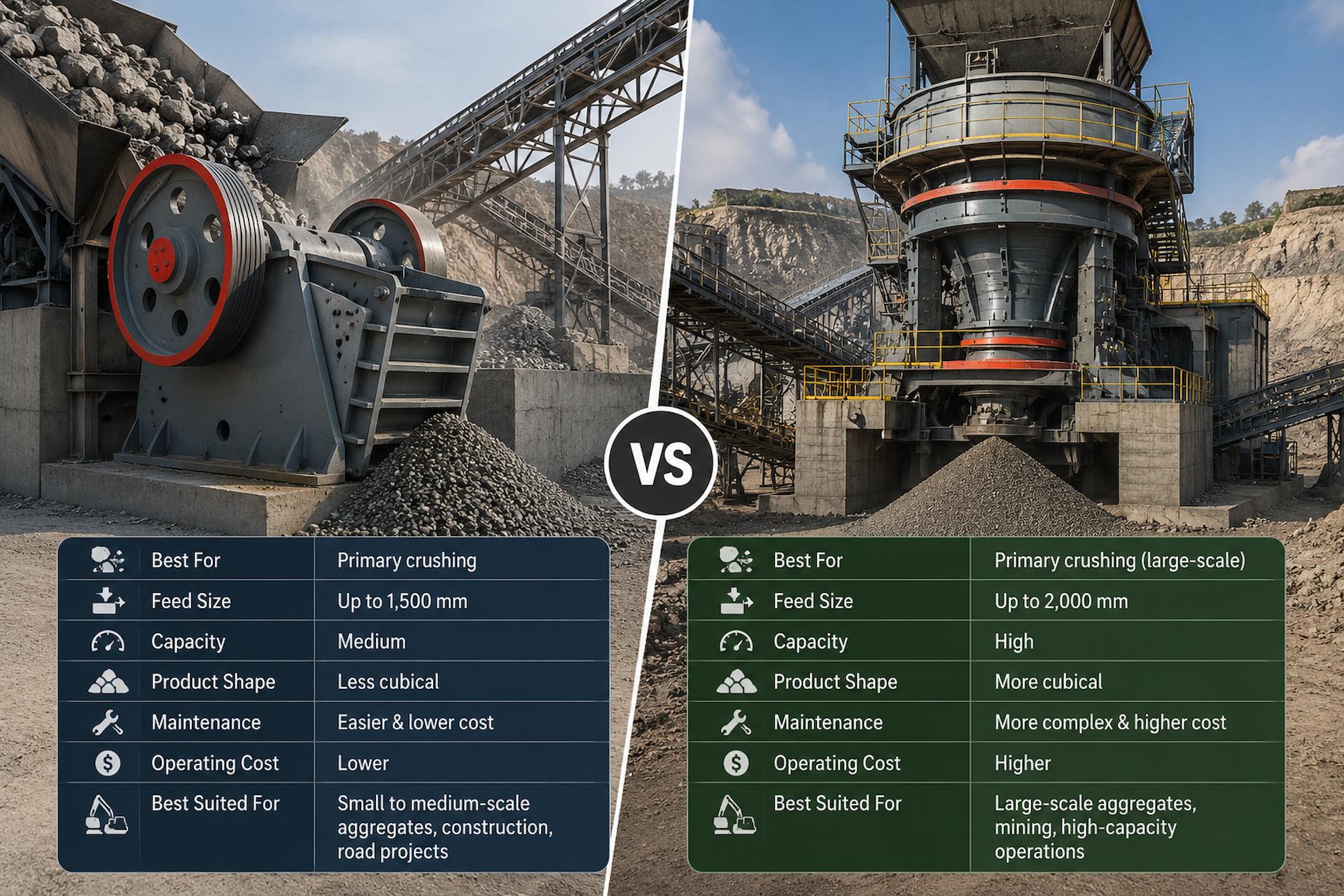
Selecting the right primary crusher can significantly affect production capacity, operating costs, and long-term efficiency in aggregate operations. When processing large volumes of material, the debate often comes down to jaw crushers versus Gyratory Crushers. Understanding their strengths, limitations, and ideal applications helps operators make smarter investment decisions.
Introduction
Large-scale aggregate production depends heavily on the efficiency of primary crushing equipment. The right crusher can improve throughput, reduce operating costs, and support consistent material processing throughout the production cycle. Among the most widely used options are jaw crushers and Gyratory Crushers, both designed to handle large rock feed and prepare material for further crushing stages. While each has distinct advantages, the best choice depends on factors such as production targets, feed size, maintenance requirements, and long-term operating efficiency. Understanding these differences is essential when selecting equipment for high-capacity aggregate operations.
1. Understanding the Role of Primary Crushing
Primary crushing is the first stage in aggregate processing. Its purpose is to reduce blasted rock into sizes suitable for secondary and tertiary crushing stages.
A primary crusher must:
- Handle large feed sizes
- Maintain consistent throughput
- Minimize downtime
- Deliver reliable performance
- Support efficient downstream operations
For large aggregate facilities, selecting the wrong crusher can lead to bottlenecks, increased maintenance costs, and reduced profitability.
1.1 What Is a Jaw Crusher?
A jaw crusher uses two plates—one fixed and one moving—to compress material. As the moving jaw approaches the fixed jaw, rock is crushed and reduced in size.
Key characteristics include:
- Simple mechanical design
- Lower initial investment
- Easy maintenance access
- Effective handling of hard materials
- Suitable for moderate to high production rates
Jaw crushers are commonly found in both quarrying and mining operations where flexibility and straightforward operation are priorities.
1.2 What Is a Gyratory Crusher?
A gyratory crusher uses a rotating mantle inside a concave surface. Material is continuously crushed as it moves downward through the crushing chamber.
Modern Gyratory Crushers are engineered for high-capacity applications and are designed to deliver reliable operation, advanced automation capabilities, optimized uptime, and efficient maintenance support. Many models also incorporate monitoring systems and automation technologies that help maintain consistent performance and reduce operating costs.
2. Capacity Comparison: Which Crusher Handles More Material?
When discussing large-scale aggregate production, capacity often becomes the deciding factor.
2.1 Jaw Crusher Capacity
Jaw crushers can process substantial volumes of material, but they operate using an intermittent crushing action. Material is crushed during each cycle of jaw movement.
Advantages include:
- Reliable performance
- Good reduction capability
- Suitable for many quarry applications
However, throughput can become a limitation as production demands increase significantly.
2.2 Gyratory Crusher Capacity
Gyratory crushers use continuous crushing action. This allows material to be processed without interruption throughout the crushing cycle.
Benefits include:
- Higher throughput rates
- Continuous material flow
- Improved efficiency in large operations
- Better suitability for high-tonnage applications
For operations requiring maximum production volumes, gyratory crushers generally provide a significant capacity advantage over jaw crushers.
3. Feed Size and Material Handling
The size of incoming rock plays a major role in crusher selection.
3.1 Jaw Crushers and Feed Size
Jaw crushers can accept large feed material and are effective in many aggregate applications.
They perform well when:
- Feed size varies frequently
- Material characteristics change
- Production requirements fluctuate
Their design offers operational flexibility across a broad range of conditions.
3.2 Gyratory Crushers and Feed Size
Gyratory crushers are specifically designed to accept very large feed sizes while maintaining high capacity.
Modern designs offer:
- Large feed openings
- High reduction capability
- Consistent crushing action
- Efficient processing of oversized material
This makes them particularly attractive for large aggregate operations processing significant quantities of blasted rock.
4. Maintenance and Reliability Considerations
Equipment downtime can be one of the most expensive challenges in aggregate production.
4.1 Maintenance Requirements for Jaw Crushers
Jaw crushers are known for their mechanical simplicity.
Benefits include:
- Fewer moving components
- Straightforward inspections
- Simplified maintenance procedures
- Lower maintenance complexity
These advantages often appeal to smaller and medium-sized operations.
4.2 Maintenance Advantages of Gyratory Crushers
Modern gyratory crushers have evolved considerably, incorporating designs that prioritize reliability and maintenance efficiency.
Several advanced systems now include:
- Automated performance monitoring
- Wear management technologies
- Real-time lubrication monitoring
- Faster maintenance access
- Enhanced operational safety features
Many modern models are engineered for faster maintenance procedures and improved component longevity, helping maximize equipment availability.
5. Energy Efficiency and Operating Costs
Long-term operating expenses often outweigh the initial purchase price.
5.1 Jaw Crusher Cost Considerations
Jaw crushers generally offer:
- Lower acquisition costs
- Lower installation complexity
- Reduced capital investment
For operations with moderate production requirements, this can create an attractive financial case.
5.2 Gyratory Crusher Cost Considerations
Although gyratory crushers typically require a higher upfront investment, they often provide benefits through:
- Higher production output
- Reduced bottlenecks
- Improved efficiency
- Better utilization of downstream equipment
Over the lifespan of a large aggregate operation, increased throughput can help offset the higher initial cost.
6. Automation and Operational Control
Technology is becoming increasingly important in modern aggregate facilities.
6.1 Jaw Crusher Automation
Many jaw crushers can be integrated into automated crushing circuits. However, their control capabilities may vary depending on the installation.
6.2 Gyratory Crusher Automation
Advanced gyratory systems frequently include:
- Automated setting adjustments
- Performance optimization tools
- Remote monitoring capabilities
- Real-time operational data
- Predictive maintenance insights
These technologies help operators maintain consistent product quality while maximizing production efficiency.
7. When Should You Choose a Jaw Crusher?
A jaw crusher may be the best option when:
- Production volumes are moderate
- Budget constraints are significant
- Operational flexibility is important
- Maintenance simplicity is preferred
- Site space is limited
Many aggregate operations continue to rely on jaw crushers because of their proven reliability and straightforward design.
8. When Should You Choose a Gyratory Crusher?
A gyratory crusher often becomes the preferred solution when:
- Maximum throughput is required
- Feed material is exceptionally large
- Long-term production goals are aggressive
- Operational efficiency is a top priority
- Advanced automation is desired
- Downtime reduction is critical
For large-scale aggregate producers, these advantages can deliver substantial productivity gains over time.
Conclusion
Both jaw crushers and gyratory crushers play important roles in aggregate production, but their strengths differ significantly. Jaw crushers offer simplicity, flexibility, and lower initial costs, making them suitable for many operations. However, for facilities focused on maximum throughput and continuous high-capacity production, Gyratory Crushers often provide a clear advantage. Their ability to process large feed sizes efficiently, support advanced automation, and maintain consistent performance makes them a strong choice for large-scale aggregate applications. By carefully evaluating operational goals, material characteristics, and long-term costs, producers can select the crusher that delivers the best overall value and productivity.