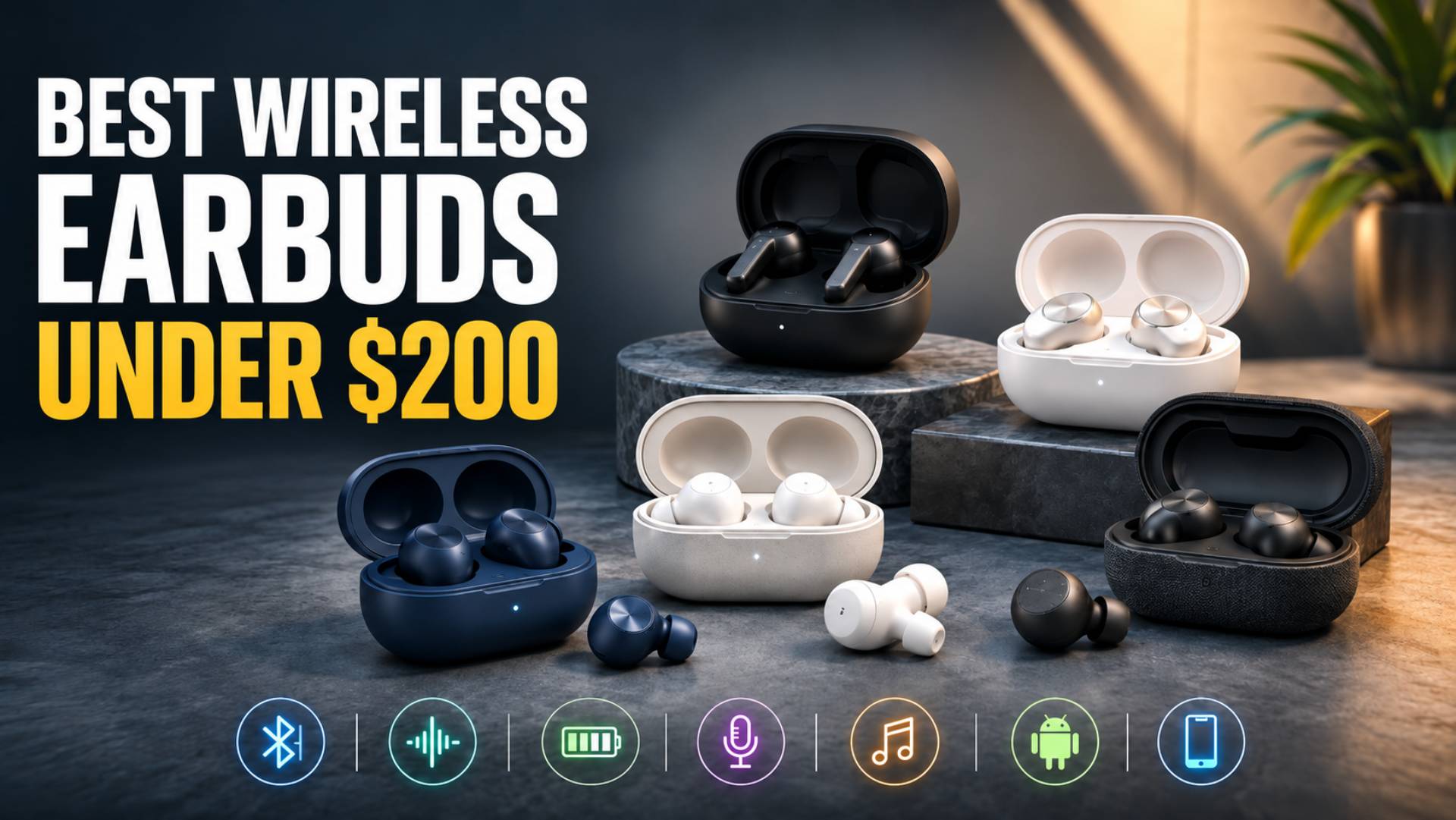
The best wireless earbuds under $200 in 2026 can deliver strong active noise cancellation, customizable sound, multipoint Bluetooth, long battery life and features that were previously concentrated in flagship models. For most buyers, our best overall recommendation is the Nothing Ear (3) because it combines strong ANC, a capable app, LDAC, wireless charging and a comfortable design while staying comfortably below $200. Bose remains the stronger choice for noise cancellation, while Cambridge Audio stands out for music-focused sound quality.
This guide is based on manufacturer specifications, current U.S. pricing and independent testing rather than undisclosed hands-on testing. Products were assessed for sound, ANC, comfort, battery life, calls, connectivity, durability, ecosystem compatibility and value. All ten models have a regular/list price below $200; none was admitted solely because a normally $250–$300 product happened to fall below $200 during a temporary sale.
Best Wireless Earbuds Under $200 at a Glance
| Category | Earbuds | Why We Chose Them | Main Trade-Off |
| Best Overall | Nothing Ear (3) | Strong ANC, LDAC, excellent app, comfortable fit and wireless charging | Microphones are less convincing than the feature set suggests |
| Best Noise Cancelling | Bose QuietComfort Earbuds | Particularly effective ANC with secure fit options | No LDAC or aptX; independent testing identified multipoint glitches |
| Best for Sound | Cambridge Audio Melomania A100 | Neutral-leaning tuning, aptX Lossless, LDAC and strong EQ options | ANC is good rather than Bose-class |
| Best for Calls | Samsung Galaxy Buds4 | Strong microphone noise rejection and Galaxy-specific Super Wideband calling | Open fit weakens isolation and may not fit every ear |
| Best for Android | OnePlus Buds Pro 3 | Dual-driver design, LHDC 5.0, multipoint and extensive Android features | Best codec advantages require compatible Android hardware |
| Best for iPhone | AirPods 4 with ANC | Excellent Apple integration, open fit, Adaptive Audio and Find My | Weak passive isolation and relatively short ANC battery life |
| Best for Exercise | Powerbeats Fit | Secure flexible wingtip design, ANC and Apple/Android support | $199.99 price is high for its feature set |
| Best Battery Life | EarFun Air Pro 4+ | Up to 12 hours/54 hours rated with ANC off | ANC is capable rather than class-leading |
| Best Feature-Rich Value | Soundcore Liberty 4 Pro | LDAC, multipoint, adjustable ANC, strong app and very fast charging | Sound tuning may need EQ for some listeners |
| Best for Pixel Users | Google Pixel Buds 2a | ANC, secure stabilizer, multipoint and excellent Google integration for $129 | No wireless charging or advanced high-bitrate codec |
The designations are use-case awards rather than artificial 1–10 scores. Different independent publications use different test fixtures, reference curves and weighting systems, so combining their results into a decimal score would create false precision.
Main Comparison Table
| Earbuds | Best For | Approx. U.S. Price* | ANC Battery | Key Codecs | Multipoint | IP Rating | Wireless Charging |
| Nothing Ear (3) | Overall | $129–$149 direct sale; list price varies | 5.5h / 22h total claimed | SBC, AAC, LDAC | Yes, 2 devices | IP54 | Yes |
| Bose QuietComfort Earbuds | ANC | $179 | Up to 8.5h; 31.5h total | Standard Bluetooth audio; no aptX/LDAC | Yes | IPX4 | Yes |
| Cambridge Audio Melomania A100 | Sound | $99 sale / $149 list | 6.5h / 21h total | SBC, AAC, aptX Adaptive, aptX Lossless, LDAC | Yes** | IPX5 | Yes |
| Samsung Galaxy Buds4 | Calls/Galaxy | $179.99 | 5h / 24h total | SBC, AAC, SSC, SSC-UHQ, LC3 | Samsung Auto Switch | IP54 | Yes |
| OnePlus Buds Pro 3 | Android | $179.99 MSRP | 6h / 25.5h total | SBC, AAC, LHDC 5.0 | Yes | IP55 | Yes |
| AirPods 4 with ANC | iPhone/open fit | $179 | 4h / 20h total | Apple/AAC-focused Bluetooth | Apple Auto Switching | IP54 | Yes |
| Powerbeats Fit | Exercise | $199.99 | 7h rated; 30h total | SBC, AAC | Apple Auto Switching | IPX4 | No |
| EarFun Air Pro 4+ | Battery/budget | $99.99 | 8h / 36h total claimed | LDAC, aptX Lossless, LC3, SBC | Yes | IP55 | Yes |
| Soundcore Liberty 4 Pro | Features/value | $149.99 direct | Up to 30h total with ANC | SBC, AAC, LDAC | Yes | IPX5 | Yes |
| Google Pixel Buds 2a | Pixel/Google | $129 | 7h / 20h total | SBC, AAC | Yes, 2 devices | IP54 buds | No |
*Prices checked September 4, 2026. Retail promotions change frequently.
**Cambridge Audio says multipoint is unavailable while LDAC is enabled on current firmware.
Official U.S. pricing confirms $179 for Bose, $179.99 for Samsung, $179 for AirPods 4 with ANC, $199.99 for Powerbeats Fit and $129 for Pixel Buds 2a. Cambridge Audio’s U.S. store showed the A100 discounted from $149 to $99 when checked.
How We Chose the Best Wireless Earbuds Under $200
Sound Quality
Sound was given the greatest editorial importance. We considered tonal balance, bass extension, midrange clarity, treble behavior, perceived detail, driver design and the usefulness of EQ controls. Where independent frequency-response or listening assessments were available, they were considered alongside specifications.
Sound remains partly subjective. A bass-heavy tuning that suits electronic music may be less attractive to someone prioritizing natural vocals or acoustic recordings.
Active Noise Cancellation
ANC was assessed separately from passive isolation. We looked for evidence covering low-frequency transport noise, offices, general city noise and transparency performance.
Independent measurements were used only when attributed to their source. Bose, for example, performed particularly well in SoundGuys’ testing, which found its ANC reduced the loudness of most tested noises by more than 80%.
Comfort and Fit
Weight, ear-tip selection, stabilizers, open versus sealed construction and independent fit observations were considered. No earbud can be declared universally comfortable because ear anatomy varies substantially.
A secure acoustic seal matters for more than comfort: it can materially change perceived bass and passive isolation and can affect how successfully ANC performs.
Battery Life
Manufacturer-rated playback was separated from independent tests whenever both were available. ANC, codec choice, listening volume, calls and spatial-audio processing can all shorten runtime.
For example, EarFun rates the Air Pro 4+ for up to 8 hours with ANC and 12 hours without it, while SoundGuys recorded 6 hours 17 minutes in its ANC test.
Microphone and Call Quality
We prioritized independent microphone samples and noise-rejection assessments where available. We did not perform our own microphone recordings.
Samsung earned the call-quality designation because SoundGuys found Galaxy Buds4 noise rejection particularly impressive, with clear speech in noisy conditions, while Samsung documents six microphones and compatible-device Super Wideband calling.
Connectivity
Bluetooth version alone does not determine connection quality. We considered multipoint, ecosystem switching, Fast Pair, codec restrictions and cross-platform limitations.
Bluetooth LE Audio is especially relevant to newer products. The Bluetooth SIG defines LC3 as the low-power codec used with LE Audio and identifies Auracast as its broadcast-audio capability.
Features and App Experience
Useful features included custom EQ, fit checks, firmware updates, control remapping, device-finding tools, low-latency modes, spatial audio and adaptive sound modes.
Features received less weight when they worked only inside a narrow ecosystem.
Durability
Official IP ratings were preferred over retailer descriptions. An IPX4, IP54 or IP55 rating indicates defined resistance under test conditions; none means an earbud is automatically safe for swimming.
Value for Money
Value was assessed against the whole competitive set rather than price alone. A $179 model can offer better value than a $99 model when it delivers a meaningful improvement in ANC, call quality or ecosystem functionality.
Rating Methodology
We did not assign numerical ratings. The evidence combines manufacturer specifications with tests from several publications whose methodologies are not identical. Editorial designations such as “Best for ANC” or “Best for Sound” communicate the conclusion without implying laboratory precision that this comparison does not possess.
Nothing Ear (3) — Best Overall Wireless Earbuds Under $200
Quick Verdict
The Nothing Ear (3) is our best overall choice because it covers more important buying criteria well than most rivals: strong ANC, LDAC, a capable companion app, dual-device connectivity, wireless charging and a comfortable in-ear design. Its greatest weakness is call quality. Independent testing found both the conventional microphones and headline Super Mic less natural-sounding than Nothing’s marketing might suggest.
Key Specifications
Typical price: $129–$149 direct when checked
Bluetooth: 5.4
Codecs: SBC, AAC, LDAC
ANC: Yes
Battery: Up to 5.5h with ANC; up to 38h total with ANC off
Charging: USB-C and wireless
Multipoint: Dual Connection, two devices
IP rating: IP54 earbuds
App: Nothing X
Best for: Buyers wanting the strongest all-round feature balance
Nothing’s support documentation confirms LDAC, AAC and SBC, while Dual Connection can maintain two classic-Bluetooth device connections.
Why We Selected Them
The Ear (3) combines features that are often split among competitors. Bose has stronger ANC specialization, Cambridge Audio has a more convincing sound-first proposition and Samsung has better call evidence, but Nothing offers a particularly balanced package.
Sound Quality
SoundGuys found the Ear (3) to have good overall audio quality but a distinctly V-shaped, bass-emphasized presentation. The Nothing X app is a major advantage because users have meaningful control over EQ rather than being locked into the factory tuning.
Listeners who prefer a warmer, more energetic presentation may enjoy the default sound. Those wanting a flatter response should plan to use the EQ.
Noise Cancellation and Transparency Mode
Independent lab testing found strong overall ANC performance and substantial low-frequency attenuation, although wind remained a weakness. That makes the Ear (3) a credible commuting option, even if Bose remains our preferred choice for buyers whose single biggest priority is suppressing environmental noise.
Comfort and Fit
SoundGuys rated the fit positively and lists four silicone tip sizes—XS through L. At approximately 5.1g per earbud, they remain fairly light. Fit still needs to be tested individually because the quality of the seal directly affects bass and ANC.
Battery Life
Nothing states up to 5.5 hours with adaptive ANC enabled and up to 38 hours of total playback under its longer-life configuration. SoundGuys measured 5 hours 12 minutes with ANC, which is close to the manufacturer’s ANC claim.
Calls and Microphone Quality
This is the clearest reason not to buy them. SoundGuys found speech from both the in-ear microphones and case-mounted Super Mic comparatively muffled. Buyers who spend hours in calls should look first at Galaxy Buds4 or AirPods 4 with an iPhone.
Connectivity and App Features
Bluetooth 5.4, LDAC, two-device Dual Connection and the Nothing X app give Android users considerable flexibility. LDAC is the headline higher-bitrate option; iPhone users will rely on AAC instead.
Pros
- Strong ANC for the price
- LDAC and dual-device connectivity
- Excellent app and EQ flexibility
- USB-C plus wireless charging
- Comfortable, distinctive design
Cons
- Microphone quality trails the strongest rivals
- Default tuning is relatively bass-heavy
- Super Mic is less useful than its marketing prominence suggests
Pricing and Value
Nothing’s U.S. pages showed different current discounts by color, including $129 and $149 configurations when checked. Even against an earlier/list price as high as $179, the model qualifies cleanly for this guide.
Best For
Commuters, Android listeners, EQ users and buyers wanting one versatile pair rather than a narrowly specialized model.
Not Ideal For
People whose main requirement is professional-sounding calls or maximum possible battery endurance.
How It Compares
The Ear (3) is more feature-balanced than the Bose QuietComfort Earbuds, while Bose offers the stronger noise-cancellation case. Cambridge Audio A100 is the better choice for listeners who place sound fidelity above ANC strength.
Editor’s Verdict
Nothing Ear (3) earns the overall recommendation through breadth rather than by winning every category. Strong ANC, LDAC, an unusually good app, useful dual-device connectivity and wireless charging make it easy to recommend below $200. Call quality prevents it from being a universal winner, but for mixed everyday use it presents one of the few packages with no major omission outside the microphone system.
Bose QuietComfort Earbuds — Best Noise Cancelling Earbuds Under $200
Quick Verdict
Choose the Bose QuietComfort Earbuds if reducing train, plane, traffic and office noise matters more than collecting the longest feature list. Bose sells them for $179 with adjustable ANC, Aware mode, multipoint, wireless charging and multiple combinations of ear tips and stability bands. Independent testing supports the ANC claim, although connection problems were observed with multipoint enabled.
Key Specifications
Price: $179
Bluetooth: 5.3
ANC: Quiet/Aware/off modes
Battery: Up to 8.5h; case up to 31.5h total
Charging: USB-C and wireless
Multipoint: Yes
IP rating: IPX4
Fit: Three tip sizes plus three stability-band sizes
App: Bose QCE app
Best for: Commuters and frequent travellers
Why We Selected Them
Bose has built this model around its core strength: noise cancellation. At $179, it delivers the practical ANC benefits associated with the brand without requiring the $299 QuietComfort Ultra Earbuds (2nd Gen).
Sound Quality
SoundGuys describes the tuning as U-shaped, with extra bass and treble. The Bose app provides EQ adjustment, so listeners who find the default presentation too energetic have some scope to modify it.
Noise Cancellation and Transparency Mode
This is the reason to buy Bose. SoundGuys measured more than 80% reduction in loudness across much of its test noise and found the ANC effective in real urban use. Aware Mode provides environmental sound when isolation is undesirable.
Comfort and Fit
Bose includes three ear-tip sizes and three stability-band sizes, creating nine combinations. This gives buyers more fit adjustment than many competitors and helps create the seal ANC requires.
Battery Life
Bose rates the earbuds at up to 8.5 hours and the case for 2.5 additional charges, reaching up to 31.5 hours total. Bose’s test notes specify Quiet Mode/full noise cancellation, making the figure particularly useful for ANC buyers.
Calls and Microphone Quality
SoundGuys found the microphones usable in most environments and reasonably effective against background noise, although very noisy situations can still reduce intelligibility.
Connectivity and App Features
Multipoint is officially supported, but SoundGuys experienced stutters and dropouts when using it. Bose also omits advanced codecs such as LDAC and aptX on this model.
Pros
- Strongest ANC recommendation in this price group
- Long rated ANC battery life
- Nine fit combinations
- Multipoint
- Wireless charging
Cons
- No LDAC or aptX
- Independent testing identified multipoint connectivity issues
- Sound signature may be too bass/treble-forward for some listeners
Pricing and Value
At its official $179 U.S. price, the QuietComfort Earbuds sit near the top of the category but still provide clear value for buyers prioritizing ANC.
Best For
Frequent flyers, commuters, office workers and listeners who want strong isolation.
Not Ideal For
Android enthusiasts prioritizing high-bitrate codecs or users who rely heavily on flawless multipoint switching.
How It Compares
Bose cancels noise more convincingly than Cambridge Audio A100, while Cambridge offers broader codec support and a more music-first sound proposition.
Editor’s Verdict
The QuietComfort Earbuds are intentionally less feature-heavy than several competitors, but that focus works. Their combination of ANC, secure fit, strong battery claims and a $179 price makes them one of the easiest recommendations for noisy environments. The main caveat is connectivity: buyers planning constant two-device switching should test multipoint during the return period.
Cambridge Audio Melomania A100 — Best Earbuds for Sound Under $200
Quick Verdict
The Melomania A100 is the strongest sound-focused option in this guide. Cambridge combines 10mm drivers, Class A/B amplification, aptX Lossless, aptX Adaptive, LDAC and a seven-band EQ. TechRadar awarded particularly strong marks for its balanced, detailed and dynamic presentation. The main limitation is that ANC, while capable, does not reach Bose’s level.
Key Specifications
List price: $149; $99 direct sale when checked
Bluetooth: 5.4
Codecs: SBC, AAC, aptX Adaptive, aptX Lossless, LDAC
ANC: Qualcomm adaptive ANC
Battery: 6.5h/21h total ANC on; 11h/39h ANC off
Charging: USB-C and Qi-compatible wireless charging
Multipoint: Yes, except while LDAC is active on current firmware
IP rating: IPX5
Weight: 4.7g per bud
App: Melomania Connect
Cambridge’s specification sheet confirms the codec set, battery figures, Google Fast Pair, multipoint, three tip sizes, low-latency mode and firmware updates.
Why We Selected Them
Many sub-$200 earbuds emphasize features before audio. Cambridge reverses that priority without stripping away practical capabilities such as ANC, multipoint or wireless charging.
Sound Quality
TechRadar found the default tuning comparatively neutral, detailed and dynamic, with good treble definition and controlled low frequencies. The app’s seven-band EQ provides room for personal adjustment without requiring users to correct an obviously extreme default tuning.
Noise Cancellation and Transparency Mode
ANC is competitive for the price, but TechRadar places it below Bose’s more complete suppression of difficult external noise. Transparency mode is included.
Comfort and Fit
At 4.7g each, the earbuds are among the lighter sealed models here. Cambridge supplies small, medium and large silicone tips.
Battery Life
The official rating reaches 6.5 hours with ANC or 11 hours without it; total case-assisted figures are 21 and 39 hours respectively. Ten minutes of charging can provide about two hours with ANC or just over three hours with it off.
Calls and Microphone Quality
Six microphones and Qualcomm cVc processing are included. The system is credible for everyday communications, though this model’s strongest reason for purchase remains music rather than calls.
Connectivity and App Features
Codec support is exceptional for the price. One important limitation deserves attention: Cambridge says multipoint is currently unavailable when LDAC is enabled.
Pros
- Excellent sound-first tuning
- aptX Lossless, aptX Adaptive and LDAC
- Seven-band custom EQ
- Multipoint and Fast Pair
- IPX5 and wireless charging
Cons
- Bose remains stronger for maximum ANC
- Multipoint and LDAC cannot currently operate together
- Only three supplied tip sizes
Pricing and Value
The A100’s normal U.S. list price is $149, already comfortably eligible. Cambridge’s direct U.S. store showed $99 when checked, which makes its current value especially strong without making eligibility dependent on that discount.
Best For
Music listeners, Android users with LDAC/aptX-compatible devices and buyers who enjoy adjusting EQ.
Not Ideal For
Anyone who values maximum ANC above sound or requires multipoint while using LDAC.
How It Compares
The A100 offers a more sound-focused package than Nothing Ear (3). Nothing provides stronger all-round ANC/app appeal, while Cambridge is the more compelling choice if music reproduction is the first criterion.
Editor’s Verdict
Cambridge Audio has produced an unusually complete music-oriented earbud for less than $200. Broad codec support, thoughtful default tuning, strong EQ and a light IPX5 design make the A100 particularly attractive to listeners unwilling to treat audio quality as secondary to lifestyle features.
Samsung Galaxy Buds4 — Best Wireless Earbuds Under $200 for Calls
Quick Verdict
Galaxy Buds4 is the call-quality standout, particularly for Samsung Galaxy owners. Samsung combines six microphones, DNN noise processing and compatible-device Super Wideband calling, while independent testing found impressive environmental-noise rejection. The central compromise is its unsealed design: fit can vary substantially, and weak passive isolation limits ANC.
Key Specifications
Price: $179.99
Bluetooth: 6.1
Codecs: SBC, AAC, SSC, SSC-UHQ, LC3
ANC: Yes, adaptive
Battery: 5h/24h ANC on; 6h/30h ANC off
Microphones: Six
IP rating: IP54 earbuds
Spatial audio: 360 Audio with head tracking on compatible Galaxy hardware
Switching: Samsung Auto Switch
App: Galaxy Wearable on supported Android devices
Samsung’s U.S. specifications confirm Bluetooth 6.1, LC3, LE Audio, Auracast, adaptive ANC and the stated battery figures.
Why We Selected Them
Voice quality is one area where independent evidence clearly differentiates the Buds4. SoundGuys found speech stayed intelligible even against substantial background noise.
Sound Quality
Galaxy devices can access Samsung’s proprietary SSC-UHQ mode at up to 24-bit/96kHz on supported hardware. Non-Samsung devices lose part of that advantage, so this is not a universal hi-res recommendation.
Noise Cancellation and Transparency Mode
ANC exists, but the open/unsealed design means passive isolation is minimal. SoundGuys found fit directly affected ANC and bass performance.
Comfort and Fit
Each earbud weighs about 4.6g. There are no silicone tips to adjust the seal, so comfort can be excellent for a compatible ear shape but frustrating for somebody whose ears do not naturally hold the body securely.
Battery Life
Samsung rates the Buds4 at up to five hours with ANC and 24 hours including the case. SoundGuys measured 4 hours 56 minutes with ANC, closely matching the published claim.
Calls and Microphone Quality
This is the strongest section. SoundGuys described noise rejection as impressive, while Samsung’s Super Clear Call system uses six microphones and compatible-device Super Wideband calling.
Connectivity and App Features
Samsung Auto Switch works across compatible Samsung devices signed into the same Samsung account; it should not be confused with unrestricted Bluetooth multipoint. Galaxy Wearable is not supported on iOS, although basic Bluetooth audio works.
Pros
- Strong microphone noise rejection
- Lightweight design
- LC3 and Samsung high-resolution codecs
- Adaptive ANC and 360 Audio
- Wireless charging
Cons
- Fit is unusually ear-shape-dependent
- Limited passive isolation
- Best features require Galaxy hardware
- No universal multipoint equivalent to Pixel/Bose/Nothing
Pricing and Value
Samsung’s current U.S. price is $179.99, placing it just under the ceiling. Its value is strongest for people already using recent Galaxy phones, where the proprietary features become relevant.
Best For
Galaxy phone owners, frequent callers and users who prefer an unsealed fit.
Not Ideal For
Frequent flyers, people needing a strong physical seal or iPhone owners wanting full app support.
How It Compares
Galaxy Buds4 beats Nothing Ear (3) on microphone evidence, while Nothing delivers a more secure sealed design and stronger all-platform feature balance.
Editor’s Verdict
Galaxy Buds4 is a specialized recommendation rather than the safest general purchase. For the right ear shape and a recent Samsung phone, its call quality and ecosystem capabilities are excellent. Buyers outside Samsung’s ecosystem should consider whether they are paying for features their devices cannot fully use.
OnePlus Buds Pro 3 — Best Wireless Earbuds Under $200 for Android
Quick Verdict
OnePlus Buds Pro 3 is an appealing Android choice for buyers prioritizing codec support and sound hardware. Its dual 11mm/6mm driver system, LHDC 5.0, Bluetooth 5.4, Google Fast Pair, multipoint and custom EQ provide a strong feature set at its $179.99 MSRP. iPhone users can connect over AAC, but they do not receive the main LHDC advantage.
Key Specifications
MSRP: $179.99
Bluetooth: 5.4
Drivers: 11mm + 6mm
Codecs: LHDC 5.0, AAC, SBC
ANC: Adaptive ANC
Battery: 6h/25.5h AAC with ANC; 10h/43h ANC off
Multipoint: Dual Device Connection
Charging: USB-C and wireless
IP rating: IP55 earbuds
App: HeyMelody
Tips: XS, S, M, L
Why We Selected Them
The combination of dual drivers, LHDC, multipoint, Fast Pair, wireless charging and a mature Android feature set gives OnePlus one of the more complete premium-style packages below $200.
Sound Quality
SoundGuys found the dual-driver setup produced substantial bass with a clear high end. The HeyMelody app includes presets, a six-band custom EQ and a BassWave control for further adjustment.
Noise Cancellation and Transparency Mode
Adaptive ANC is standard. OnePlus markets very high theoretical attenuation figures, but those lab/marketing numbers should not be treated as a guarantee of real-world reduction. Independent impressions indicate useful suppression, but Bose remains the safer ANC-specific choice.
Comfort and Fit
Four tip sizes broaden fit options, while the 5.29g per-earbud weight is competitive.
Battery Life
OnePlus rates AAC playback at 6 hours with ANC and 25.5 hours including the case. With ANC off, those figures rise to 10 and 43 hours. LHDC plus ANC reduces the official rating to five hours per charge and 21.5 hours total.
Calls and Microphone Quality
Three microphones plus a voice-pickup sensor and AI processing are used. SoundGuys found useful background-noise suppression but did not position the microphones as class-leading.
Connectivity and App Features
LHDC 5.0 is the differentiator, supporting high data rates on compatible devices. Bluetooth multipoint and Google Fast Pair add everyday practicality. Buyers should check whether their particular phone supports LHDC before treating the codec as a purchasing reason.
Pros
- Dual-driver audio system
- LHDC 5.0
- Multipoint and Fast Pair
- Wireless charging
- Long ANC-off battery life
Cons
- LHDC support is device-dependent
- iPhone users fall back to AAC
- ANC is not the strongest in this group
Pricing and Value
OnePlus has consistently positioned Buds Pro 3 at a U.S. retail value of $179.99, keeping the product below the $200 ceiling without relying on a temporary discount.
Best For
OnePlus owners, Android enthusiasts, listeners using compatible LHDC hardware and buyers wanting dual drivers.
Not Ideal For
iPhone-focused buyers or people who want class-leading ANC.
How It Compares
Compared with Cambridge A100, OnePlus offers tighter integration with its own Android ecosystem, while Cambridge supports a broader collection of advanced codecs including LDAC and aptX Lossless.
Editor’s Verdict
The Buds Pro 3 makes most sense as an Android audio product rather than a universal recommendation. On compatible devices its combination of LHDC, dual drivers, multipoint and custom sound tools is compelling; without LHDC support, some of that differentiation disappears.
Apple AirPods 4 with Active Noise Cancellation — Best Under $200 for iPhone
Quick Verdict
AirPods 4 with ANC is the obvious sub-$200 choice for iPhone users who dislike silicone ear tips. At $179, Apple combines an open fit with ANC, Adaptive Audio, Transparency mode, Personalized Spatial Audio, Voice Isolation, Find My and a wireless-charging case. The open construction is also its biggest limitation because passive isolation and deep-bass consistency depend heavily on ear shape.
Key Specifications
Price: $179
Bluetooth: 5.3
Chip: Apple H2
ANC: Yes
Battery: 4h/20h total ANC on; 5h/30h off
Charging: USB-C, Qi and Apple Watch charger
IP rating: IP54
Spatial audio: Personalized, with dynamic head tracking
Find My: Yes
Best for: iPhone owners wanting an open fit
Why We Selected Them
Apple ecosystem features remain unusually cohesive. Pairing, switching, Find My, spatial features and Siri interactions require less setup than most third-party alternatives.
Sound Quality
SoundGuys found respectable tuning for an unsealed design but noted early sub-bass roll-off. An open fit cannot produce the predictable seal available from silicone-tipped earbuds, so sound varies more between listeners.
Noise Cancellation and Transparency Mode
ANC is impressive considering the unsealed construction but should not be confused with Bose-class isolation. SoundGuys found limited low-frequency suppression relative to sealed designs. Transparency and Adaptive Audio are particularly natural fits for this form factor.
Comfort and Fit
There are no ear tips. That simplicity is exactly why some people love AirPods, but it also means there is no way to change the acoustic seal or mechanically secure them for a different ear shape.
Battery Life
Apple rates ANC playback at up to four hours per charge and 20 hours with the case; switching noise control off increases those figures to five and 30 hours. A five-minute case charge provides roughly one hour.
Calls and Microphone Quality
SoundGuys found calls generally clear in ordinary environments, particularly when paired with an iPhone because part of Apple’s voice processing occurs on the phone.
Connectivity and App Features
Bluetooth 5.3 is used. On Apple devices, automatic ecosystem switching substitutes for traditional cross-platform multipoint. Apple explicitly notes that AirPods can be used as ordinary Bluetooth headphones with non-Apple equipment but functionality may be limited.
Pros
- Excellent iPhone integration
- Useful ANC in an open design
- Strong transparency/Adaptive Audio
- Find My and spatial audio
- Wireless charging
Cons
- Weak passive isolation
- Four-hour official ANC runtime
- Fit cannot be adjusted with tips
- Many benefits disappear outside Apple hardware
Pricing and Value
The official U.S. price remains $179. Retailers may discount the model, but no discount is needed for eligibility.
Best For
iPhone owners, open-fit fans and people who value transparency and ecosystem convenience.
Not Ideal For
Frequent flyers, listeners requiring deep passive isolation or Android users seeking maximum feature access.
How It Compares
AirPods 4 offers much better Apple integration than Galaxy Buds4 or OnePlus Buds Pro 3, while Bose delivers substantially more predictable isolation because it forms a physical seal.
Editor’s Verdict
AirPods 4 with ANC is not the technically strongest earbud in every category, but it is unusually convenient for an iPhone user who refuses silicone tips. Buy it for integration and open-fit comfort, not because its ANC or battery life beats sealed competitors.
Powerbeats Fit — Best Wireless Earbuds Under $200 for Exercise
Quick Verdict
Powerbeats Fit wins the exercise designation because its flexible wingtip creates a more secure mechanical hold than ordinary stem-style earbuds. It includes ANC, transparency, IPX4 resistance and full Apple integration while retaining an Android companion app. At $199.99, however, it sits one cent below the article’s limit and its value proposition is weaker than several $100–$150 competitors.
Key Specifications
Price: $199.99
Bluetooth: 5.4 according to independent testing
Codecs: SBC, AAC
ANC: Yes
Battery: Up to 7h; 30h with case
Fast charging: 5min ≈ 1h playback
IP rating: IPX4 earbuds and case
Charging: USB-C
Wireless charging: No
Weight: 5.78g per bud
Tips: XS, S, M, L
Why We Selected Them
The wingtip is the defining feature. During running, lifting or fast movement, physical stability can matter more than an extra codec or another hour of case battery.
Sound Quality
The Beats platform offers Adaptive EQ and Personalized Spatial Audio with dynamic head tracking on supported Apple hardware. There is no full custom EQ, which limits adjustment compared with Nothing, Cambridge or Soundcore.
Noise Cancellation and Transparency Mode
SoundGuys found ANC useful but not exceptional and praised the natural transparency mode. That balance makes sense for exercise, where maximum isolation may be undesirable outdoors.
Comfort and Fit
Four ear-tip sizes are included, but the wingtip itself comes in one size. That means stability can be excellent for compatible ears while the fixed wing shape may create pressure for others.
Battery Life
Beats rates seven hours per charge and 30 hours with the case. SoundGuys measured approximately 7 hours 10 minutes with ANC enabled in its test, a positive result.
Calls and Microphone Quality
This is not a strength. Independent microphone testing found mediocre voice reproduction and weaker background-noise rejection than the best premium alternatives.
Connectivity and App Features
Apple users receive Automatic Switching, Audio Sharing, Find My, Fit Test and hands-free Siri through the H1 platform. Android users get one-touch pairing, controls, battery status, Locate My Beats and Fit Test through the Beats app.
Pros
- Secure wingtip design
- Good exercise stability
- Apple and Android support
- ANC plus strong transparency mode
- Solid measured battery life
Cons
- Expensive at $199.99
- Only one wingtip size
- IPX4 rather than a stronger protection rating
- No wireless charging
- Mediocre microphone performance
Pricing and Value
At $199.99, Powerbeats Fit technically meets the “under $200” rule without depending on a discount, but buyers are paying heavily for fit, Beats styling and Apple integration.
Best For
Runners, gym users and Apple owners who struggle to keep ordinary earbuds secure.
Not Ideal For
Value shoppers, heavy callers or users seeking advanced codecs.
How It Compares
Pixel Buds 2a provides a secure stabilizer and better value at $129, while Powerbeats Fit offers the more pronounced wingtip hold and deeper Apple integration.
Editor’s Verdict
Powerbeats Fit is a specialist purchase. Its secure design earns its place for exercise, but it would rank lower as a general-purpose $200 earbud because cheaper alternatives deliver stronger apps, codecs or microphones.
EarFun Air Pro 4+ — Best Wireless Earbuds Under $200 for Battery Life
Quick Verdict
At $99.99, EarFun Air Pro 4+ combines unusually long rated battery life with a feature list normally associated with more expensive earbuds. EarFun claims up to 12 hours per charge and 54 hours total with ANC off, or eight and 36 hours with ANC. It also supports LDAC, aptX Lossless, LC3, multipoint, wireless charging and IP55 resistance.
Key Specifications
Price: $99.99
Bluetooth: 6.0 listed by EarFun
Drivers: Dynamic + balanced-armature hybrid
Codecs/features: LDAC, aptX Lossless, LC3, Auracast
ANC: Adaptive hybrid ANC
Battery: 8h/36h ANC; 12h/54h ANC off
Multipoint: Yes
IP rating: IP55 according to manufacturer
Charging: USB-C and wireless
App/EQ: Yes
Why We Selected Them
Battery is the headline, but this is not a one-dimensional product. Advanced codec support, dual drivers and multipoint make the price particularly aggressive.
Sound Quality
SoundGuys found the hybrid driver system delivered strong overall sound and useful treble detail, with extensive EQ presets available when the default presentation does not suit the listener.
Noise Cancellation and Transparency Mode
ANC is effective for a sub-$100 model but does not threaten Bose. SoundGuys measured a meaningful improvement in environmental-noise reduction with ANC enabled and described performance as broadly average for current wireless earbuds.
Comfort and Fit
SoundGuys rated comfort positively. As with any sealed earbud, buyers should test multiple tip sizes to achieve an effective seal.
Battery Life
EarFun’s official ceiling is 12 hours/54 hours with ANC off and 8 hours/36 hours with ANC on. SoundGuys’ standardized ANC test produced 6 hours 17 minutes, demonstrating why manufacturer maximums should not be treated as guaranteed runtime.
Calls and Microphone Quality
Six microphones are used. Independent testing found office and street performance respectable but wind more difficult.
Connectivity and App Features
The feature matrix is unusually extensive: multipoint, LDAC, aptX Lossless, LC3, Auracast, wireless charging and custom EQ all appear in EarFun’s specifications.
Pros
- Longest headline battery figures in this shortlist
- $99.99 price
- Wide codec support
- Multipoint
- Wireless charging and IP55
Cons
- Independent ANC runtime is below the maximum rating
- ANC is not class-leading
- Wind can challenge the microphones
Pricing and Value
The official $99.99 price makes this one of the strongest inexpensive alternatives in the article. Unlike a discounted $250 flagship, eligibility does not depend on a temporary sale.
Best For
Students, travellers who prioritize case endurance, Android users and budget-conscious feature seekers.
Not Ideal For
People willing to pay considerably more specifically for Bose-level ANC or Samsung-level calling performance.
How It Compares
Soundcore Liberty 4 Pro has a more polished ANC/control proposition, while EarFun provides longer official battery figures and broader modern codec support at a lower price.
Editor’s Verdict
EarFun demonstrates how competitive the sub-$100 segment has become. Its maximum battery numbers should be treated as ideal-condition claims, but even after that qualification the overall combination of runtime, codecs and connectivity is difficult to ignore.
Soundcore Liberty 4 Pro — Best Feature-Rich Value
Quick Verdict
Soundcore Liberty 4 Pro is a feature-heavy alternative for buyers who enjoy adjusting their earbuds. Adaptive ANC, multipoint, LDAC, HearID customization, Google Fast Pair, a smart-case display and exceptionally quick charging give it unusual flexibility around $150. Independent testing confirms good ANC and sound, though it does not displace Bose for noise cancellation.
Key Specifications
Direct price when checked: $149.99
Bluetooth: 5.3
Codecs: SBC, AAC, LDAC
Drivers: 10.5mm + 4.6mm dual-driver system
ANC: Adaptive ANC 3.0
Battery: Up to 10h/40h ANC off; manufacturer gives up to 30h total with ANC
Fast charging: 5min ≈ 4h playback
Multipoint: Yes
IP rating: IPX5
App: Soundcore with HearID
Official Soundcore documentation confirms Bluetooth 5.3 and SBC/AAC/LDAC support.
Why We Selected Them
Few competitors combine this many practical controls at the price. The charging-case display is not essential, but ANC adjustment, EQ and fast charging are genuinely useful.
Sound Quality
SoundGuys describes Liberty 4 Pro as good-sounding overall, with the Soundcore app providing substantial room for personalization.
Noise Cancellation and Transparency Mode
Independent measurements found strong low-frequency reduction for the category, although still below the best premium ANC systems. Transparency can be adjusted to a high level for conversation and awareness.
Comfort and Fit
At about 5.5g per bud, the design remains reasonably light. Soundcore also provides fit-oriented controls inside the companion ecosystem.
Battery Life
The official maximum is 10 hours per charge and 40 hours with the case under favorable settings. SoundGuys measured 5 hours 42 minutes with ANC; Soundcore states up to 30 hours total when ANC is used.
Calls and Microphone Quality
Six microphones and algorithmic wind/noise reduction are used. Call quality is serviceable, but microphone performance is not the primary reason to choose this model.
Connectivity and App Features
Multipoint and Fast Pair are supported. LDAC is available for compatible Android devices; iPhones cannot use the LDAC benefit.
Pros
- Excellent feature density
- Good ANC for the price
- LDAC and multipoint
- Extensive app customization
- Extremely fast five-minute top-up
Cons
- Bose remains stronger for pure ANC
- Maximum battery ratings fall with ANC/LDAC
- Case display adds complexity some buyers will not need
Pricing and Value
Soundcore’s U.S. page showed $149.99 when checked, although the model has appeared at lower promotional prices. It remains competitively priced even without requiring the promotion.
Best For
Tinkerers, commuters, Android users and buyers wanting premium-style features without a premium price.
Not Ideal For
Minimalists or listeners whose only criterion is the most natural factory tuning.
How It Compares
EarFun Air Pro 4+ costs less and claims longer battery life, while Liberty 4 Pro provides the stronger ANC/control-focused package.
Editor’s Verdict
Liberty 4 Pro is one of the strongest value propositions for buyers who actually use companion-app features. It gives up some refinement to specialist rivals, but offers enough ANC, sound customization, charging speed and connectivity to make $149.99 feel reasonable.
Google Pixel Buds 2a — Best Wireless Earbuds for Pixel Users Under $200
Quick Verdict
Pixel Buds 2a is the practical Google choice at $129. It combines ANC, Transparency mode, a twist-to-adjust stabilizer, IP54 protection, Fast Pair, Find Hub, Gemini integration and genuine two-device multipoint. Battery life is competitive, but Google omits wireless charging and sticks to SBC/AAC rather than LDAC or aptX.
Key Specifications
Price: $129
Bluetooth: 5.4
Codecs: SBC, AAC
Driver: 11mm dynamic
ANC: Silent Seal 1.5
Battery: 7h/20h ANC; 10h/27h ANC off
Multipoint: Two devices
Charging: USB-C only
IP: IP54 earbuds; IPX4 case
Tips: XS, S, M, L
Weight: 4.7g per bud
Why We Selected Them
Pixel Buds 2a turns Google’s lower-priced line into a much more complete product by adding ANC and multipoint while preserving the lightweight secure-fit design.
Sound Quality
Google provides an 11mm driver and five-band EQ. SoundGuys found the sound solid rather than category-leading, which is a fair characterization: this is an ecosystem/value recommendation rather than an audiophile one.
Noise Cancellation and Transparency Mode
SoundGuys measured useful ANC performance but found a remaining high-frequency weakness. For commuting and office use it is meaningful, though Bose offers a larger step up for dedicated noise suppression.
Comfort and Fit
The 4.7g earbuds use Google’s twist-to-adjust stabilizer. Users can rotate them toward a more secure position for activity or a more relaxed position for long sessions. Four tip sizes are supplied.
Battery Life
Google rates the earbuds at seven hours with ANC and 20 hours including the case, rising to 10 and 27 hours with ANC off. SoundGuys measured about 6 hours 46 minutes with ANC, close to the official figure.
Calls and Microphone Quality
Google includes Clear Calling and wind-blocking mesh, while independent testing found the microphones adequate for general use. They are not as differentiated as Galaxy Buds4’s call system.
Connectivity and App Features
Google explicitly supports simultaneous connections to two Bluetooth sources, including combinations involving laptops, tablets, televisions, Android devices and iPhones.
Pros
- $129 regular U.S. price
- True two-device multipoint
- Secure twist stabilizer
- Useful ANC
- Strong Pixel/Google services integration
Cons
- No wireless charging
- No LDAC or aptX
- Several advanced Google features require Android
- Sound is solid rather than exceptional
Pricing and Value
The current Google Store U.S. price is $129. Cached promotional pages show previous $99 deals, but those should not be treated as the normal current price; the official regular price is the appropriate figure for this guide.
Best For
Pixel owners, Android users who prioritize multipoint and buyers wanting a secure lightweight design.
Not Ideal For
Codec-focused audiophiles or anyone who expects wireless charging.
How It Compares
Pixel Buds 2a is less feature-heavy than OnePlus Buds Pro 3 but offers a simpler Google-centric experience at a much lower price.
Editor’s Verdict
Pixel Buds 2a is easy to recommend to Pixel users because its strengths match the ecosystem: Fast Pair, Find Hub, Gemini features, multipoint and a secure lightweight design. Buyers unconcerned with Google’s software can obtain broader codec support elsewhere.
How to Choose Wireless Earbuds Under $200
Sound Quality
Start by deciding what kind of sound you actually enjoy. A neutral or balanced presentation is useful if you want vocals and instruments reproduced without strong bass or treble emphasis. Bass-focused tuning may be more enjoyable for hip-hop, electronic music and gym use.
EQ matters because it reduces the risk of buying the wrong default tuning. Cambridge A100, Nothing Ear (3), OnePlus Buds Pro 3 and Soundcore Liberty 4 Pro all provide meaningful adjustment.
Codec support should be treated as one part of the audio chain rather than proof that an earbud automatically sounds better. LDAC, aptX Adaptive, aptX Lossless and LHDC can provide higher-bandwidth options on compatible devices, but driver quality, tuning, fit, source material and listening environment remain important.
Active Noise Cancellation
If you regularly commute, fly or work around HVAC, traffic or office noise, ANC deserves a high place in your priorities. Bose is the strongest ANC-focused option here.
If most listening happens at home, spending more for a small ANC advantage may deliver less practical benefit than investing in better sound or battery life.
Remember that passive isolation and ANC work together. An unsealed design such as AirPods 4 or Galaxy Buds4 cannot physically isolate external sound as consistently as well-fitting silicone-tipped earbuds.
Fit and Comfort
Fit is one of the most underestimated specifications because it cannot be captured reliably in a table. An earbud can receive excellent comfort reviews and still feel wrong in a particular ear.
Poor fit may reduce bass response, weaken ANC and cause the earbuds to loosen during movement. Buyers should use the included alternative tips and any app-based fit test rather than assuming the preinstalled medium tips are correct.
For exercise, consider a stabilizer or wing. Powerbeats Fit makes security its central design feature, while Pixel Buds 2a uses an adjustable stabilizer.
Battery Life
Compare battery figures under the conditions you actually plan to use. “Up to 54 hours” may refer to ANC being off, modest volume and repeated case charging.
If you use ANC all day, focus on the ANC-on earbud figure. If you mainly need several days between charging the case, total system endurance matters more.
Fast charging can be as valuable as maximum endurance. Soundcore’s claim of up to four hours from five minutes in the case is particularly useful for buyers who regularly forget to charge overnight.
Android vs iPhone
Android buyers have the widest codec choices, depending on handset support. LDAC appears on Nothing, Cambridge, EarFun and Soundcore; OnePlus uses LHDC 5.0; Cambridge also supports aptX Adaptive and aptX Lossless.
iPhone users should give more weight to AAC performance and ecosystem integration than to codecs their phones do not use. AirPods 4 offers automatic Apple-device integration, Find My and Personalized Spatial Audio, while Powerbeats Fit brings many Apple conveniences to a more exercise-focused form.
Samsung owners receive extra Galaxy-specific codec, call and 360 Audio capabilities from Galaxy Buds4. Pixel owners gain the greatest software integration from Pixel Buds 2a.
Calls and Work
Frequent callers should prioritize microphone noise rejection, multipoint and transparency rather than assuming an expensive earbud automatically has a better mic.
Galaxy Buds4 is our leading call recommendation, especially with compatible Galaxy hardware. AirPods 4 is also credible when paired with an iPhone. Nothing Ear (3) is a poorer fit for a call-first buyer despite its heavily promoted case microphone.
Multipoint is valuable for office users switching between a computer and phone. Bose, Nothing, Cambridge, OnePlus, EarFun, Soundcore and Pixel all provide forms of two-device connectivity, although specific codec restrictions may apply.
Exercise
At minimum, look for a secure fit and an appropriate sweat-resistance rating. IPX4 is commonly sufficient for sweat and splashes, while IPX5/IP54/IP55 designs provide different combinations of tested water and, where the first digit is present, dust protection.
Do not interpret these ratings as permission to swim with the earbuds. Check the manufacturer’s exclusions before exposing a product to heavy rain, showers or immersion.
Transparency is useful outdoors because it can preserve awareness of vehicles and other hazards. For running near traffic, situational awareness may matter more than maximum ANC.
What Should You Expect From Wireless Earbuds Under $200?
The under-$200 category no longer means accepting basic Bluetooth earbuds. Our 2026 shortlist demonstrates that buyers can reasonably expect ANC, transparency, USB-C charging, app control and at least splash/sweat resistance, with multipoint and wireless charging common on many models.
Under $50: Products can sound good and may include ANC, but microphone processing, app polish, transparency and fit accessories are more likely to involve compromises.
$50–$100: Competition becomes much stronger. EarFun Air Pro 4+ demonstrates that advanced codecs, multipoint and wireless charging can now appear around $100.
$100–$150: This is arguably the strongest value band. Pixel Buds 2a, Nothing Ear (3), Cambridge A100 during current pricing and Soundcore Liberty 4 Pro compete on features once associated with flagship models.
$150–$200: Buyers are increasingly paying for specialization: Bose for ANC, Samsung for Galaxy calling/ecosystem features, OnePlus for Android audio functionality, Apple for iPhone integration and Beats for workout security.
Above $200: Premium models may further improve ANC, transparency, microphones, hearing-related functionality, spatial processing or materials, but performance does not rise in a straight line with price.
When Spending More Than $200 Makes Sense
Moving above $200 can be justified when a particular premium feature has high daily value. Examples include stronger flagship ANC, more advanced hearing or protection features, proprietary spatial-audio systems, improved microphones or deeper ecosystem integration.
Samsung, for example, prices Galaxy Buds4 Pro at $249.99 while the standard Buds4 in this guide costs $179.99; Bose’s QuietComfort Ultra Earbuds (2nd Gen) sits at $299 against $179 for the standard QuietComfort Earbuds.
The extra spending makes less sense if your requirements are straightforward music, podcasts, commuting and occasional calls. In that situation, models such as Cambridge A100, EarFun Air Pro 4+ and Soundcore Liberty 4 Pro already cover most practical needs at substantially lower prices.
When Cheaper Earbuds May Be Enough
You probably do not need to spend near $200 if you mainly listen to podcasts, need a backup pair, use earbuds only at the gym or rarely encounter environments where sophisticated ANC matters.
The strongest evidence comes from the products themselves. EarFun’s $99.99 Air Pro 4+ already provides ANC, modern codecs, multipoint, wireless charging and long rated battery life. Cambridge Audio’s $149-list A100 delivers a particularly strong music package, while Pixel Buds 2a brings ANC and true multipoint to Google’s $129 tier.
Pay for a $179–$199 model when you can identify the specific benefit you are buying—Bose ANC, Apple integration, Samsung call features or Beats’ wingtip stability—not simply because a higher price appears more premium.
FAQs
What are the best wireless earbuds under $200?
Nothing Ear (3) is our best overall choice for most buyers because it combines strong ANC, LDAC, wireless charging, dual-device connectivity, extensive EQ controls and a comfortable design at well below $200. Bose QuietComfort Earbuds is stronger for dedicated ANC, while Cambridge Audio Melomania A100 is our sound-quality pick.
Are $200 wireless earbuds worth it?
Yes, if the extra money buys a feature you use frequently. Around $150–$200, buyers can get stronger ANC, ecosystem integration, better fit systems or specialized call features. If those benefits do not matter to you, excellent $100–$150 alternatives may offer better value.
Which earbuds under $200 have the best noise cancellation?
Bose QuietComfort Earbuds is our ANC pick. Bose sells it for $179, and independent SoundGuys testing found the ANC reduced the loudness of most tested environmental noise by more than 80%.
Which wireless earbuds under $200 have the best sound quality?
Cambridge Audio Melomania A100 is our sound-focused recommendation. It combines a relatively balanced default tuning with aptX Lossless, aptX Adaptive, LDAC and seven-band EQ. Sound remains subjective, so bass-oriented listeners may prefer a different tuning.
What are the best wireless earbuds under $200 for Android?
OnePlus Buds Pro 3 is our Android-focused pick, particularly for compatible LHDC devices. EarFun Air Pro 4+, Cambridge A100, Nothing Ear (3) and Soundcore Liberty 4 Pro are excellent alternatives for Android users seeking LDAC, aptX or broader codec flexibility.
What are the best wireless earbuds under $200 for iPhone?
AirPods 4 with Active Noise Cancellation is the strongest iPhone-specific option if you like an open fit. It integrates Find My, Adaptive Audio, spatial features and automatic Apple-device behavior more deeply than third-party alternatives. Buyers wanting a sealed design should also consider Bose or Nothing.
How much should I spend on wireless earbuds?
For many buyers, $100–$150 is the current value sweet spot. Spending closer to $200 is easiest to justify for specialized ANC, secure sports fit or ecosystem features. Below $100, feature quality varies more, although products such as EarFun Air Pro 4+ show how competitive the category has become.
How long should wireless earbuds last?
Single-charge runtime now commonly reaches several hours, but long-term product lifespan is different from runtime. Rechargeable lithium batteries gradually lose capacity through charge cycles and age. Firmware support, charging habits, physical damage and whether batteries can be serviced all affect useful lifespan, so buyers should not interpret an “8-hour battery” specification as a durability guarantee.
Are expensive earbuds always better?
No. Higher-priced models may offer stronger ANC, more sophisticated microphones or ecosystem features, but the relationship between price and performance is not linear. A $100–$150 model can outperform a $200 product in a specific category such as codec support or battery life.
Which features matter most when buying wireless earbuds?
Prioritize fit first, then sound, ANC, battery and microphone quality according to your actual usage. After that, check multipoint, app quality, device compatibility, codec support, IP rating and charging options. Features that your phone cannot use should carry little weight in the decision.
Final Recommendations
Choose Nothing Ear (3) if: you want the most balanced combination of ANC, sound customization, LDAC, charging options and everyday features.
Choose Bose QuietComfort Earbuds if: noise cancellation matters more than advanced codecs.
Choose Cambridge Audio Melomania A100 if: music quality and codec flexibility are your highest priorities.
Choose Samsung Galaxy Buds4 if: you take frequent calls and already use a compatible Galaxy phone.
Choose OnePlus Buds Pro 3 if: you use Android hardware that can exploit LHDC and want a dual-driver design.
Choose AirPods 4 with ANC if: you use an iPhone and specifically prefer an open fit.
Choose Powerbeats Fit if: secure fit during running and gym sessions matters more than maximizing value.
Choose EarFun Air Pro 4+ if: you want long battery ratings and a broad feature set around $100.
Choose Soundcore Liberty 4 Pro if: you want extensive app controls, LDAC, good ANC and extremely fast charging.
Choose Pixel Buds 2a if: you want Google integration, multipoint and a secure lightweight design for $129.
For most buyers, the best wireless earbuds under $200 depend less on finding a universal winner than on deciding whether ANC, sound, calls, battery, ecosystem compatibility, exercise stability or price matters most.